
UV-XUV time-resolved photoelectron spectroscopy
Femtosecond time-resolved spectroscopies enable the investigation of ultrafast molecular dynamics by combining pump and probe pulses. Among these techniques, time-resolved photoemission spectroscopy (TRPES) is particularly suited to studying non-adiabatic processes, as it provides information on both vibrational dynamics and electronic configurations. Conventional UV–UV TRPES has been widely used to investigate molecular relaxation pathways; however, its typical temporal resolution of approximately 100 fs limits the observation of early-time dynamics. Moreover, the low kinetic energy of photoelectrons generated by UV probe pulses increases their susceptibility to inelastic scattering, thereby restricting the accessible observation window.
In our research, we employ high-order harmonic generation (HHG) for probe pulses with photon energies in the extreme-ultraviolet (XUV). In conventional HHG setups, an intense femtosecond pulse is focused onto a gas target. When macroscopic phase matching in the gas is ensured, the highly non-linear response of the medium leads to the coherent production of XUV radiation, resulting in a train of attosecond pulses. For specific applications (including TRPES), selecting a single harmonic from the broad spectrum is essential (e.g., avoiding the excitation of numerous ionization channels). This selectivity is achieved with a time-delay compensated monochromator (TDCM), which allows us to obtain XUV monochromatized pulses with a record temporal duration of 5 fs. By combining them with sub-20 fs UV pulses, we are able to investigate the ultrafast relaxation mechanisms in organic molecules.
Investigation of non-adiabatic dynamics in isolated molecules
Excited-State Intramolecular Hydrogen Transfer
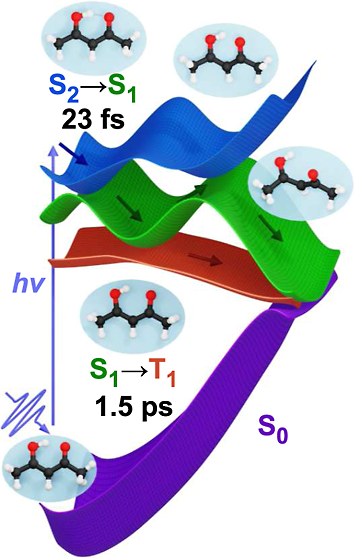
Excited-State Intramolecular Hydrogen Transfer (ESIHT) is one of the fastest chemical reactions, occurring on the order of tens of femtoseconds and playing a critical role in light-driven biological processes and technological applications. We have investigated the early stages of coupled nuclear-electron dynamics using acetylacetone as a model system exhibiting ESIHT. Our results provide distinct spectroscopic signatures of ESIHT occurring within the first 20 fs and resolve the active vibrational modes, showing the intricate evolution of the electronic and nuclear degrees of freedom.
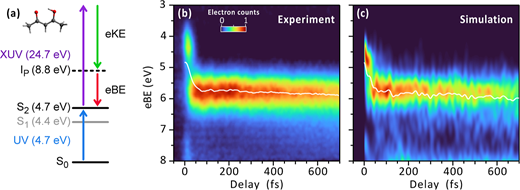
Tr-PES of acetylacetone. (a) Diagram of the experiment: a UV pump pulse excites the system in the S2 level and an XUV probe ionizes it; the resulting electron Binding Energy (eBE), or equivalently the electron Kinetic Energy (eKE), tracks the induced dynamics. Experimental (b) and simulated (c) evolution of the eBE as a function of the pump and probe delay. Both traces show a rapid increase of the eBE in the first tens of femtoseconds, followed by a higher binding energy signal exhibiting a periodic chemical shift. In white, superimposed to the traces, is the evolution of the center of mass.
To know more: https://doi.org/10.1021/jacs.5c06327
Substituents effects on non-adiabatic dynamics
The photoinduced non-adiabatic dynamics of organic cyclic compounds are at the basis of many biological and chemical relevant functions. We aim at deciphering the role of functional groups in these dynamics.
Ultrafast dynamics of bio-molecules in their natural environment
Photochemical processes drive key biological phenomena such as photosynthesis and DNA photoprotection. However, the underlying molecular mechanisms governing these processes remain largely elusive. Their ultrafast nature, combined with the complex interplay of multiple degrees of freedom, poses significant challenges for direct observation and control.
The project FASTBIO will pioneer an approach for TRPES in solution with unprecedented temporal resolution to access poorly understood physical phenomena occurring in the first few femtoseconds after photoexcitation in DNA building blocks and protein model systems in their natural aqueous environment. 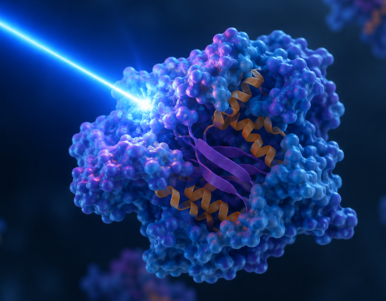
DNA is naturally photostable, minimizing harmful photochemical reactions. FASTBIO will study the molecular mechanisms of energy dissipation in DNA subunits, revealing internal conversion, exciton formation, and charge transfer processes, including solvation effects.
We will then focus on engineered protein models. The structural complexity of natural photosystems challenges the observation of key ultrafast processes regulating their photoresponse, but de novo-designed model proteins offer a simplified platform to study these dynamics. FASTBIO will investigate how the first passages of charge transfer and energy transfer are influenced by protein conformation, providing crucial insights into light-harvesting systems.